
Nonviolence is a Tactic
I have no interest in saving people's souls, only their lives, so I'm indifferent to moral arguments that the Minnesota protestors should stay nonviolent. But that's not the only argument to make.

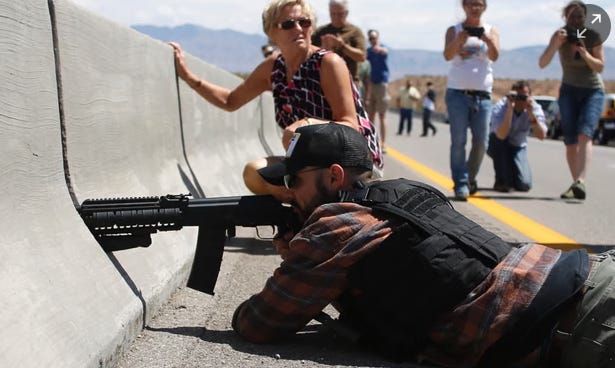
“Should liberals form well-regulated militias?” asked Jonathan V. Last of The Bulwark. He raised this question in the half-joking tone of voice you use when you’re not sure whether you’re kidding on the square or whether you’re whistling past the graveyard. Pointing out that significantly well-armed groups of right-wing protestors had been treated much more gently by the police than disarmed groups of left-wing protestors - such as Clive Bundy, who lead a 400-strong militia to point rifles and shotguns at federal employees lawfully attempting to repossess his cattle for failure to pay his debts, or the masked militia members with rifles in 2020 who broke into the state capitol in Michigan in order to threaten the legislators out of issuing health restrictions meant to stop the spread of coronavirus - JVL suggested that, perhaps, Renée Good and Alex Pretti were killed by agents of the federal government not because they posed a threat to the agents of the federal government but specifically because they posed no threat, and thus could be murdered without consequence.
I believe that while JVL has the right idea by assuming that the federal agents who chose to kill Alex Pretti and Renée Good did so because they knew they were safe and not because they thought they were in danger, JVL ends up confusing cause and effect when it comes to the presence of guns. The presence of guns in all of these cases has served as an excuse for the police to do the things that they already wanted to do. During the Malheur standoff, the police wanted to force the Bureau of Land Management employees to release the cattle that Clive Bundy was demanding to be allowed to steal from them - the guns that the Bundy militia brought were a good reason to tell the federal employees to back off by citing the possibility of a bloodbath. During the unprovoked beating of Alex Pretti, the assembled gang of CBP officers wanted to murder Alex Pretti - the gun that he never touched and was immediately disarmed of provided a convenient enough justification to summarily execute him. In both cases, the people with badges did what they wanted, and used the guns to justify it; heavily arming the protestors against ICE might change the incentives faced by their agents, but it certainly won’t change what ICE wishes to do to them.
After coming to the conclusion that “the resistance arming and organizing itself would be morally correct,” JVL reaches deep within his soul to his Christian faith. Quoting extensively from the Beatitudes, he states that the conflict in Minneapolis, like the conflict in American history to abolish slavery and Jim Crow, is fundamentally a moral battle, and moral battles aren’t won with weapons. Drawing out the comparison, article by article, verse by verse, he makes the case that God calls us to support the protestors in Minneapolis, and that their actions are consistent with every moral principle he has derived from the Christian martyrs, and that the actions of ICE and CBP are clear parallels to the earthly tyrants who had caused that martyrdom.
As reassuring as it would be to think that God is on our side - not that God is on our side, of course, JVL assures everyone, God just agrees with us - I cannot follow JVL down this path, as I do not share the same priors. JVL is a faithful and dutiful Catholic, who ultimately believes that God organizes an Unseen World of which the Seen World is but a passing reflection - luminous beings are we, not this crude matter. I, personally, believe that my consciousness is no more likely to survive the death of my body than 85 miles an hour is to survive the four-car pileup. If a six-year-old boy is orphaned by an ICE agent who fires three bullets into his mother then calls her a “fucking bitch”, when it comes to getting that six-year-old boy justice, we will only ever get one bite at the apple.
If we fail that six-year-old boy, I believe we fail him forever.
It would be nice to think there was a safety net somewhere, some hereafter where wrongs could be made right again, our sins and failings forgiven.
But I can’t think that. It’s not a part of me.
So I am not particularly moved by the moral case that the protestors in Minneapolis should remain unarmed. I want as few nurses as possible executed on the street for helping women up, as few people as possible teargassed, beaten, or blinded for filming the police in the street, and as few children as possible to come home to discover that their parents are missing with no clue as to where they are save an Ace of Spades. Should these tragedies happen, I want the people responsible to face justice in order to discourage future killers from thinking that they can shoot someone’s wife without facing any consequences.
But the moral case is not the only case that someone could make. Someone could argue that nonviolence puts a strategic pressure on Donald Trump that violence would alleviate, allowing him to get off easy.
“By any means necessary” has to include non-violent means. Obviously. If nonviolent means work better to get what you claim you want, and you refuse to use them, the logical conclusion is that all you actually want is violence and an excuse for it.
“Nonviolence” is one of those worship-words that sounds good on casual inspection, just like “nonprofit” does. “Nonprofit” sounds great, since greedy people looking to maximize their profit cause a lot of problems in the world; wouldn’t it be nice if there was an organization that didn’t care about it? Then you move to California, and you find out that “nonprofit” is just a word for a company that you aren’t allowed to stop using because they’re paid by the government. Similarly, “nonviolence” sounds good. Violence is bad, wouldn’t it be nice if we promised not to do any of it?
Like with most high-minded ideals, it runs aground on the details of specific circumstances. Is it still a “nonviolent” protest if the police attack you without provocation, and a bunch of scared people surrounded by tear gas and the screams of their friends run into the line of police as they try to escape the chaos? Even if the protest remains nonviolent, what happens if the police break windows while launching tear gas canisters at the protestors then blame them for it? What happens if people opposed to the protests attack the police while disguised, in the hopes that the resulting violence will kick off what they call “Civil War 2: Electric Boogaloo”?
And there’s the fact that nonviolence is, honestly, a lot to ask. It sounds simple and easy, because it sounds like you’re just maintaining the civilizational obligation we all have not to assault the people who disagree with us. But the thing about nonviolent protests is that they provoke a violent response. In response to the Civil Rights Movement, beatings, disfigurement, blindings, and even murder would be encouraged by the police (when not actively committed by them) and nullified by sympathetic all-white juries and judges if it ever went to trial. It is hard to get someone to sign up for a cause when your pitch includes “You may be murdered, and if you are, your murderer will go unpunished. This is necessary so that we can continue to maintain the moral high ground.”
It disgusts me that I would have to ask that of anyone. It disgusts me not just as a human being, but as an American. “Life, liberty, and the pursuit of happiness” means exactly that; while I understand that every generation of Americans must always be ready to declare “give me liberty or give me death”, I have no respect for anyone who attempts to give them death. And it viscerally upsets me to think that I would ask someone to, in order to be granted the ballot that is their birthright as an American citizen, cross the Edmund Pettis Bridge, be beaten by the thugs of the Alabama Highway Patrol, and passively do nothing as they are clubbed into unconsciousness because exercising their inalienable right to self-defense might frighten someone.
In 2020, police officer Derek Chauvin kneeled on the back of Minneapolis citizen George Floyd for nine minutes, watching him slowly die as he begged to be allowed to breathe. When protests started, it was easy to see why liberals quickly staked out a position that wasn’t pro-violence but was absolutely anti-anti-violence. These protests were against the police, who were one of the two groups of people who could turn the protests violent. Liberals didn’t want to create an incentive for the police to start a bunch of fights, then point to the fights as proof that the police were necessary. A protection racket is bad enough; a protection racket that cites the fire they started as proof that they’re needed is intolerable.
Plus, it just feels better. It creates a permission structure for hurting people and breaking things, and hurting other people and breaking their things is fun. Confessing your weakness by saying “We voluntarily cede the right to defend ourselves” isn’t nearly as emotionally satisfying as darkly intimating “If you don’t do what we want, who knows what might happen? We might just burn the city down.”
In 2020, fifteen million people in a country of three hundred and thirty million took to the streets in protest over George Floyd; in 1963 Martin Luther King Jr. lead a quarter of a million marching on Washington in a country of a hundred and eighty million. If Martin Luther King could get the Civil Rights Act of 1964 passed with 0.1% of the country’s population marching in the streets of the nation’s capital, how much more could 4.5% of the country’s population accomplish?
Not much, as it turned out.
The organizers of the March on Washington couldn’t agree about what the March on Washington was supposed to be for, with some groups there supporting the Kennedy administration’s Civil Rights Act, some groups arguing that the proposed Civil Rights Act wasn’t going far enough, and some groups condemning the Kennedy administration’s failure to have already passed the Civil Rights Act. A crowd of two hundred and fifty thousand people is going to have two hundred and fifty thousand reasons for being there. But once they’re there, they’ll hear one speech - Martin Luther King’s “I Have A Dream” speech, forcefully citing chapter and verse to say that America had failed to live up to the promises of liberty and freedom that it made.
What did the George Floyd protestors want? Unlike the March on Washington, there was no centralized leader or group of leaders who could transmute the righteous belief of fifteen million individuals that something needed to be done into a list of ten specific demands. We can only impose order on the movement in hindsight, by hearing what slogans the people chant without anyone else at the protest feeling a need to contradict them. And there was one slogan that emerged from the primordial soup of protest - “defund the police”.
When they were asked what exactly that meant, most people proceeded to say that this was not actually referring to a plan to stop paying the police and then seeing what happened, but rather doing something to control the ever-expanding budgets of the police force in exchange for burdening the police with less responsibilities, which was a very bad sign; as a general rule, successful slogans do not need someone to immediately explain that they don’t mean what you could easily interpret them to mean. The truth is that there were a small, measurable number of people who did want to simply stop having police, occasionally suggesting that they replace them with entirely new organizations serving the exact same functions but deemed more politically reliable; these “police abolitionists” were over-represented among the organizers of the protests. (After all, they had been objecting to the existence of police long before George Floyd was killed and will continue to object to them even if no black person is ever slowly strangled to death by one again. They were already there.)
“Defund the police” became a way of not having to say which of the two sides of the debate you were on. If you were being cornered in responsible society and asked whether or not you supported anarchy when you said “defund the police”, you would say “of course not!” and insist that “defund the police” only meant that limited idea of reducing the scope of the police. If you were being cornered by activists who asked whether or not you were going to submit to their demands, you would say “of course I do!” and agree that “defund the police” meant that their idea of replacing the police with community struggle sessions called “empathy ceremonies” where they decide if suspected criminals are enslaved for the rest of their lives or ritualistically drowned was great. It was a way to agree with whoever you were talking to at the time.
While the core of politics has always revolved around making vague promises that things will improve and counting on everyone listening to interpret those vague promises as the policies that each individual voter wants, rarely have such diametrically opposed visions for society tried to find common ground in the same political movement. Does “defund the police” mean that we should go over their budget line item by line item asking whether or not the NYPD really needs more money per year than the armed forces of Ukraine? Does it mean that we should get rid of all of the police, and then whenever we find a criminal we should turn around for a few minutes, and when we look back someone else should have done something to make the criminal disappear and we don’t have to think about it anymore? Does it mean that we should fire every police officer and then re-hire different people who are more like us to do the exact same jobs? Yes, it does! It means all of those things!
Anarchy for some, increased spending on social services for others!
Many people have written histories of the leaders of nonviolent movements like Reverend Martin Luther King Junior or Mahātmā Gandhi focus on the strong faith these men had and the moral certainty their faith brought them in their causes. It’s literally in their names. Martin Luther King is named for Martin Luther, the seminal figure of the Protestant reformation; Mahātmā, a honorific applied to Gandhi worldwide, means ‘great-souled’ in Sanskrit. These men saw themselves as priests first and protestors second, using their position as moral leaders to urge human beings to act better towards each other, waging a spiritual war as opposed to a physical one.
But we should consider something important about them. They won their war. The people who tried to fight a physical war did not.
Both British rule in India and Jim Crow had no shortage of people willing to commit violence for and against it. The first body identified from a mass grave of more than a hundred people killed in the Tulsa Race Massacre was a veteran of World War I; it would take the East India Company over a century of constant warfare to subjugate the Indian subcontinent. The problem was never that there were people unwilling to fight those who sought to conquer them; the problem was that the conquerors were able to bring more force to bear against the people they conquered.
It is easy to see nonviolence as either Christlike suffering, martyrdom offered on behalf of an undeserving population in order to save them from themselves, or as a submissive plea, begging bullies and tyrants to stop hurting you because it isn’t fair. It is harder to see what Martin Luther King referred to as “soul force”, to comprehend that responding to someone hitting you by staring them in the eye and asking them if they feel like a big man now can be a statement of strength rather than weakness. To offer someone undeserved mercy is to threaten them with the idea that nothing they can do to you poses a threat.
Small wonder that Jonathan Ross, the ICE agent who killed Renée Good, ignored Renée’s wife in the passenger seat, who was yelling “You wanna come at us? You wanna come at us? I say go get yourself some lunch, big boy” and instead chose to shoot three times the person whose last words to him were “That’s fine, dude, I’m not mad at you”. If he could not make Renée Good hate and fear him, what was the point to being there with a gun in the first place?
By definition, no government can afford to coerce every one of its citizens at every time. It’s a simple question of numbers. The government takes a tiny fraction of everyone’s productive labor and uses that to pay a much smaller number of people to ensure that everyone else obeys the law. If every person required a police officer watching them at every hour of the day in order to make sure that they obeyed the law, you would have to employ half of the country as police officers. And even if you did that, then who would police the police officers?
In order to work, any government must convince the population to either cooperate with it or submit to it. Generally, the government wants to do both; as Machiavelli says in The Prince, “it would be best to be both loved and feared”. The government wants to be loved for what it can provide to the people that cooperate with it, and simultaneously to be feared for what it can do to the people who refuse to submit to it.
The best way to be loved and feared by people at the same time is to be loved for the fear you create in their enemies. And it is very easy to convince someone that people unlike them are enemies.
Pick a man’s pocket, and when he demands his money back, shove him to the ground. When he throws a punch, draw a gun and shoot him dead. “I had no choice,” you explain, “He punched me, completely unprovoked. I feared for my life.” People will debate for hours whether or not it was appropriate or necessary for you to shoot a man who punched you, but they’ll rarely ask what you were doing stealing and shoving him in the first place - so long as you make it winkingly clear that none of the good people have to worry about having their wallets stolen by you.
White people did not fear losing their ballot or their bathroom under Jim Crow. White people do not fear losing their freedom or their citizenship to ICE raids. They understood that these degradations were targeted at people who were not them, and that while they were permitted to care about them, if they wanted to, they never had to worry about them. And everyone worries about criminals. So by declaring your political enemies violent criminals, by emphasizing all the things that make them different from “normal” people, you encourage the crowd of ordinary people to see themselves less and see their enemies more.
Jesse Watters from Fox News understood the assignment. When Renée Good was killed by Jonathan Ross, he immediately moved to excommunicate her from sympathy in the eyes of his audience. “The woman who lost her life was a self-proclaimed poet from Colorado with pronouns in her bio,” he said, reminding the audience that this was not one of us but one of them. “The Daily Mail says she leaves behind a lesbian partner and a child from a previous marriage.” Mentioning that she married the woman in the passenger seat who was forced to watch her wife die after the death of her first husband might have made her seem human to the audience. Sympathy couldn’t be allowed. “She was a disruptor,” he said, clearly communicating that no one watching the show needed to worry about ending up like her - not as long as they understood their place.
What do you do about this? The forces of repression are defending in depth. Whenever they get caught killing someone, they slander the dead, making up whatever reasons they need to in order to justify their murder - JD Vance referred to Alex Pretti as an “attempted assassin” and Kristi Noem described him as a “domestic terrorist” who “wanted to inflict maximum damage on individuals and to kill law enforcement.” Whenever they inflict fear and terror on part of the populace, they remind the rest of the populace that it’s only those wicked Negro agitators and the poets from Colorado getting hurt, and that none of the “good people” have cause to worry about the violence of the state being turned on them - so long as they don’t try to interfere with the state’s violence, that is.
This defense held. It held in the face of violence brought by people resisting it, and it held in the face of arguments that it was deeply unfair and ought to stop. The state could bring more physical force to bear against those who resisted it than those who resisted it could bring; and the people who worried about what would happen if the world became more fair could bring more political force than those who cared about the world becoming fairer could bring.
When the defense fell, it fell to a force more powerful. Soul force. I don’t believe that the nonviolent protestors changed the minds of the populace; even before the marches people generally either knew that Jim Crow was wrong, or knew that it was wrong but supported it anyway because they benefited from it. Even when you look at the people who argued in favor of segregation, they very rarely said that it was good that white people were keeping all of the best bus seats and bathrooms for themselves; they pretended that they had no choice but to do it because permitting equality would have “violent and anarchistic consequences”, allowing “mob rule” to “end civilization”.
I believe that by fighting back in this way, they put a very specific sort of pressure on the government. The government must be able to convince people to cooperate with it, or threaten people into submitting to it. It must be either loved or feared. When faced with nonviolent protests, the government can repress the protests, which makes it harder for the government to be loved. Or the government can ignore the protests, which makes it harder for the government to be feared.
Wherever the government wants to rule by fear among one section of the population but rule by love among the rest of them, nonviolence forces them to choose.
The government can violently repress the protestors and blame them for provoking the violence. It will always blame them. There was nothing that Alex Pretti could have done to not be declared a domestic terrorist the moment the government killed him. But public shows of nonviolence make it substantially harder to make that case. If a man clearly has the opportunity to violently resist and just as clearly foregoes the opportunity to violently resist, it becomes harder for others to believe that he terrified you and you had no choice but to kill him. Not hard to say; nothing except someone’s own sense of shame can stop them from saying that “Alex Pretti approached police officers carrying a firearm” when the video clearly shows that Alex Pretti had no intent to draw that firearm and the gun was removed from the scene before Alex was ever shot. But harder to believe.
Even for people who fully understand that the subtext of these acts is supposed to be “you should not care about what happens to these enemies of the state because it will never happen to you”, the more unprovoked the violence, the more people will understand that it may come for them some day. Alex Pretti’s last act on earth, the act that caused him to be jumped by several CBP agents and summarily executed by them, was to help a woman up off the ground. His death sends the clear message that anyone who tries to help someone off the ground who was thrown there by DHS is taking their lives into their own hands. And while plenty of people understand that ICE is willing to beat people for very little provocation, those people can tell themselves “Well, I would never insult an officer, record him making arrests, or speak Spanish in public, so I’m safe.” But if people are being asked to find out whether or not the government approves of it before they help a neighbor off the ground, they will begin to see this as a far more annoying intrusion on their day-to-day lives.
The more violence the government commits, the higher the cost of cooperating with the government becomes. Violence is disruptive. It leaves widows, orphans, bystanders. People who will remember, and people who will hate you for the rest of their lives. And people who will hate anyone who cooperates with you. It’s one thing to say “We support our brave police officers, who get free parking spaces” with a sign outside your grocery store when the police officers are known for arresting shoplifters and pickpockets; it’s quite another to put that sign up once the local police officers are mostly known for a series of vicious, unprovoked assaults. Best if no one has to ask exactly why you support the police.
The more violence the government uses, the harder it is to rule through love.
If violence makes things harder for the government, why is it used in the first place? Some of it is just the inevitable misaligned incentives of principal and agent. A man with a billy club knows that he can get away with beating someone with it, and so he does what comes naturally - any consequences for his violent vacation will be paid by other people at some point in the future, and he gets to enjoy the feeling of power that comes from hurting someone helpless right now. But the government understood what this man was going to do with the billy club when it handed it to him. The government gave him the billy club because it understood that people will demand less of them if they think that making those demands might be met with violence.
If people resist in ones and twos, trickling in, then one or two of those people could be killed (or otherwise made a very public example to others), and the rest of the people would stop following that example, and the government would have time to settle the disruption caused by the murder before the fear let up enough that they needed to kill someone new. If hundreds to thousands of people resist at once, the government is outnumbered. For every one example they create of someone who defied them and was killed, there will be thousands of examples of people who resisted and were fine.
People will obviously be more intimidated by a tiny prospect of being killed than reassured by a near-certainty of surviving. As the IRA said after failing to assassinate Margaret Thatcher, “Today we were unlucky, but remember we have only to be lucky once.” But courage is not the absence of fear, it is overcoming it, and it is easier to overcome fear when you know that you have a community at your back.
And the government would much rather rule through the fear of force than force itself. Force is risky; force is expensive; force is disruptive. Fear is much cheaper. You don’t even need to use the weapon that causes the fear. An ICE officer greeted a woman filming him by asking “Haven’t you learned your lesson from the last few days?” a few days after Renée Good was shot and killed. This ICE agent didn’t want to go through all of the trouble that would have resulted if he killed the woman filming him; he didn’t even want to go to the trouble that would have resulted from issuing an explicit death threat, laughing and refusing to answer when woman filming him asked “what lesson is that?” just before he knocked the phone out of her hand. He just wanted to exploit the fear caused by the murder of Renée Good to bully someone.
The less violence the government uses, the harder it is to rule through fear.
Martin Luther King’s tragic assassination lead to him being granted the status of a secular saint. Racially conservative people seeking to claim themselves as heirs to King’s legacy tastefully remove his radical demands that America live up to the promises that it had made towards its black citizens, reducing his “I Have A Dream” speech to one single line about how he hopes that “my four little children will one day live in a nation where they will not be judged by the color of their skin but by the content of their character”, as though his only request was that people generally decide to treat each other more kindly.
If Martin Luther King wasn’t a figure that would have castigated them, Mississippi and Alabama wouldn’t have made his federal holiday also Robert E. Lee Day, meant to honor both the priest who urged America to uphold its Constitution and the general who committed treason in defense of slavery so that he could kidnap anyone who looked like that priest, chain them and whip them, pour brine into the bleeding wounds, then separate them from their families and sell their children as cattle.
But they aren’t the only ones who sand off the sharper edges to make it easier for themselves to claim the legacy of Martin Luther King as their heritage.
Martin Luther King was an idealist, yes. But he was also a strategist.
The nonviolent protests by Martin Luther King were razor-focused on the task of making it harder for Jim Crow to exist. Martin Luther King organized marches, yes, one of which famously ended on the Edmund Pettus Bridge, with a mob of deputized white citizens lead by the Alabama Highway Patrol falling on 600 nonviolent marchers and beating many of them unconscious, leaving future Representative John Lewis with a fractured skull and scars he would bear for the rest of his life. But these marches were not symbolically meaningful commutes; they were targeted attacks at a specific part of the functioning of Jim Crow.
The easiest way to prevent black people from voting was to prevent them from registering to vote. Therefore Jim Crow worked in part by making it as hard as possible to register to vote; registration paperwork had to be done in-person at the town courthouse, which was open for registration only two days out of every month. Clerks at that courthouse understood perfectly well that their job was to use ostensibly neutral laws to prevent black people from successfully registering to vote and neglect to enforce those laws when white people showed up. They would use “literacy tests” that included questions with more than one correct answer, then tell the black registrant that they failed the test because they were required to give the other answer. They would refuse to give black citizens paperwork or throw it away once it was filled out. They would arrest white people who attempted to turn in a black person’s registration paperwork. All of these things - poll taxes, literacy tests, inconvenient registration procedures - made voting slightly harder for white people and voting massively harder for black people, because the people enforcing the laws understood that they were intended to only be actually enforced on black people.
Martin Luther King’s marches were designed to organize hundreds of people with the media watching and have them all arrive at the courthouses where they were supposed to be allowed to register to vote. The forces of Jim Crow would have three choices. They could permit the marchers to register to vote, thereby surrendering to their demands. They could deploy the exact same set of spurious regulations to prevent anyone from registering to vote, thereby allowing the media to exhaustively record government employees refusing to do the jobs that they claim to have.
Or they could respond with violence. Legal or extralegal violence, whether it’s arresting all of the marchers when they arrive at the courthouse or putting a call out to every single white citizen above the age of twenty-one to arm themselves and ambush the marchers on a bridge before they even get close to the courthouse. But so long as the media is documenting the march, and the people at the march refuse to act to defend themselves, there is clearly no justification beyond the naked admission that “we do not want these black people to be allowed to vote, and will beat them into the hospital if they stand in front of us and peacefully ask for the ballot.”
The government is caught in a fork. They can surrender to the protest’s demands by allowing voter registration, they can make it harder to rule through fear by creating legal records of their refusal to work, or they can make it harder to rule through love by responding with clearly and completely unprovoked violence.
Modern protest culture completely ignores the tactical aspects of the protests in favor of the aesthetic of protest. Marches travel from symbolic location to symbolic location chanting slogans. Activists for a group calling themselves Just Stop Oil enter museums and spill soup and mashed potatoes on historical paintings, provoking a wave of copycats. A rowdy street protestor in Minneapolis attempts to light a dumpster on fire, and when a local civil rights lawyer asks him to stop, the protestor punches the lawyer in the face. None of these protests target anything vital or even relevant to the injustices they are meant to protest. All of them can be safely ignored by the powers that be; thus, they will be ignored by the powers that be.
When confronted on this, the activists in question fall back on several rote defenses. They point out that Martin Luther King’s protests were widely unpopular with the white community in America; therefore it should be no surprise that their protests are similarly considered to be bad ideas. This assumes the inevitability of what Martin Luther King fought hardest to overcome; it is the equivalent of saying that since in 2016 the New England Patriots won the Super Bowl after being down 28-3 midway through the third quarter of the game, you intend to allow the opponent to score four touchdowns and then see what happens.
They point out that Martin Luther King used the fact that his followers were arrested unjustly to fill the prisons to the point where the sheriffs of the South had no choice but to release the protestors so they still had room to put away thieves and murderers; they propose that breaking the law and being arrested for it should be seen not as a regrettable but inevitable consequence of opposing an unjust system but as a useful goal to be pursued in itself. This is no different from saying that your plan in a war is to have as many soldiers surrender to the enemy as possible, so that once they are in the prisoner of war camps they can eat all of the food available for the enemy’s army.
Lastly, they say that the cause they are advocating for is so righteous that their tactics should be immune to criticism. Surely the more important the cause, the more important the choice of tactics is. Only a selfish narcissist would care more about whether they are seen opposing injustice than stopping that injustice. Only the arrogantly vain would imagine that the most effective way they could advocate for a cause would be to let everyone know that they support it. The higher the stakes, the greater the danger posed by doing things that make us feel good instead of working.
Doing the things that feel good and ignoring why they were done in the first place has transformed modern protest from a way to change the world into an outdoor block party designed to celebrate the people who previously changed it, a secular version of one of those ogre-slaying festivals portrayed in anime where the entire rustic Japanese village gets together to re-enact the time centuries ago that the hero slew the demon. Come to Kitakami Village and remember when the Loyal Three heroically mugged Ogerpon; and once you’ve had your fill of popping balloons and stalls offering commemorative mochi, perhaps you’d like to abolish the police?

Any analysis of a specific tactic must include an assessment of when the tactic is likely to work, and when the tactic is likely to fail. Nonviolence - when considered as a tactic, rather than as a moral principle - relies on exploiting the tension between a government that wants to use the threat of unprovoked violence in order to keep part of the population subdued and simultaneously wants to haughtily deny that it would ever use violence except when it was strictly necessary. A government that does not seek to disguise the fact that it rules by fear or a government that seeks to avoid ruling by fear where possible would not be vulnerable to this tactic.
Gandhi, when interviewed in 1946, said that the Holocaust was “the greatest crime of our time. But the Jews should have offered themselves to the butcher’s knife. They should have thrown themselves into the sea from cliffs.” Horrifying as this sounds, Gandhi does have a theory of how the tactic might have worked. “It would have aroused the world and the people of Germany”, forcing them to admit that the Jews were dying en masse. He points out that the people killed by the Nazis were dead anyway. “As it is, they succumbed anyway in their millions.”
I disagree with the great-souled one on this point. Firmly. The Holocaust was a secret in the way that the uncle serving ten years in federal prison for bank robbery is a family secret, not in the way that the spare key inside a rock in the garden outside is a family secret. It was protected not by being hidden from view but by being too shameful to talk about. The Nazis did not publicly state their intent to carry out a “final solution to the Jewish problem”, but they did not do anything to hide the fact that they were loading as many Jewish people as possible into train cars, driving those trains to prison camps with crematoriums that ran night and day, and that none of those Jewish people were ever seen again. Plenty of German citizens at the time would make dark jokes to each other that missing things “must have ended up where all of the Jews did”; the Allied forces were perfectly aware of what Germany was doing in its concentration camps but scrupulously pretended not to be, because if they were aware of it they might become morally obligated to stop ignoring it. Drawing attention to the Holocaust by voluntarily dying in public would have just saved the Nazis some time; everyone already knew it, they just preferred to pretend that they didn’t.
So a government that uses a great deal of violence to rule almost exclusively by fear will not be vulnerable to nonviolence. A government that uses as little fear as possible will similarly be protected.
Occupy Wall Street was a protest started in 2011 after seeing a similar movement in Egypt called Occupy Tahrir Square bring down the Egyptian government; the Occupy Tahrir Square model would also work in 2014 to bring down the Russia-backed Ukrainian government in what was known as the Euromaidan or the “Revolution of Dignity”. Occupy Wall Street’s theory of change was that protests force governments to surrender to their demands by being too large to violently suppress and too disruptive to tolerate; therefore, by simply gathering a large enough number of rowdy enough people in one place who demanded that the government change, the government would be changed.
Occupy Tahrir Square and Euromaidan succeeded and Occupy Wall Street failed because the Egyptian president, Hosni Mubarak, and the Ukrainian president, Viktor Yanukovych, ruled by fear in ways that the American government simply did not. When you rely on intimidation to keep people from changing your government, a huge number of people in the streets chanting “We will not be intimidated” poses a huge threat to your government. When you regularly have free and fair elections to change your government, a huge number of people in the streets chanting “We will not be intimidated” does not pose a huge threat to your government, because the government seeks to beat them at the ballot box, not to intimidate them. If they truly represented a massive silent majority, they would have won the election in the first place.
Hosni Mubarak and Victor Yanukovych had to order their militaries to open fire on the Tahrir Square protestors and Independence Square protestors because if people thought that they were allowed to protest the government without being intimidated, it would signal a death knell for the system’s power to intimidate. Occupy Wall Street could be safely ignored because America, for large part, did not need to resort to intimidation in order to get most people to obey the government. Even in 2020, when activists in Seattle seized Cal Anderson Park, barred the police from entering, and declared it the “Capitol Hill Autonomous Zone”, the city was able to wait out the protestors like a parent whose child announces that they are running away from home patiently sits on the porch waiting for them to realize that they have no other source of food or shelter and return home. Most reenactions of My Side of the Mountain end before six people are shot and one murdered by heavily armed anarchists there to provide ‘protection for the community’, but CHAZ was not so lucky.
With that in mind, are we currently in the sweet spot where nonviolence makes sense as a tactical measure? Is the government seeking to intimidate the citizens of Minneapolis, and simultaneously deny that it would ever intimidate the citizens of Minneapolis? Absolutely.
The tactics of the government and the tactics of the protestors are constantly changing. Originally, DHS sought to organize large raids that would capture as many people they saw as racially undesirable as possible; in Chicago, the city’s residents got whistles and blew them whenever they saw DHS approach, warning people who were at risk of abduction that they needed to hide or otherwise escape the incoming kidnappers. In Minneapolis, DHS switched to a new tactic of lightning abductions, driving around the city, waiting until they saw one or two racially undesirable people alone and vulnerable, and piling out of their car to quickly snatch them up and take them to prison within minutes, without having any idea who the person they targeted for kidnapping was.
Protestors responded by following DHS cars around Minneapolis, constantly recording them, and shouting for people who were being abducted by DHS to tell the observers their names and other identifying information so that lawyers could be informed who had been taken and families could be notified why one of their members disappeared one day, as DHS refuses to either provide its prisoners with legal representation or inform their family members about what happened to the people they disappear. DHS adapted by threatening the protesting observers, adding their names to databases, showing them that DHS knew where the observers lived, and murdering two of them in Alex Pretti and Renée Good.
DHS closed ranks around the killers in both cases, using force to prevent the state police from securing the crime scene, sending the people guilty of the murder out of the state to put them beyond the bounds of justice, and announcing that there would be no investigation into the murderers because both Pretti and Good deserved what they got. With that in mind, and with how unprovoked the killings were in the first place, it’s easy to assume that DHS wanted Pretti and Good to be shot dead in order to intimidate the rest of the observers. Of course the DHS didn’t want to investigate the killings; that would be like the Seattle Seahawks defensive line announcing that they were hiring independent investigators to find out how opposing quarterback Drake Maye could possibly have been sacked six times during the Super Bowl. The people who did it were doing exactly the jobs they were sent there to do.
It would be easy to assume that, but it would still be wrong.
DHS wanted Pretti and Good to be murdered, yes. But more than that, DHS didn’t want to be held responsible for the murder. It wanted them deniably dead. Because there was so much video of Pretti and Good’s murders, and it clearly showed how they remained nonviolent, there was no room to make any sort of plausible denial.
This does not stop them, obviously, from making implausible denials. They will still seek to impede in every way anyone’s attempt to get justice on behalf of Pretti or Good by punishing their murderers. But they stand in the way of justice not just because they want to protect their own employee and tell their employees that DHS will have your back even when you murder American citizens for no reason, but because the workings of justice in the courts and media pose a greater threat to them than any benefit they would derive from killing Pretti and Good in the first place.
One of the bystanders recording the DHS officers surrounding Renée Good as she slowly died shouted “You can’t kill us all, Nazis!” Purely as a matter of counting bullets in guns and heads in the crowd, it’s worth remembering that they could have. If DHS chose to escalate the situation to mass violence and simply opened fire aiming to kill as many protestors as possible, it is very likely that they would murder at least thirty to forty people before the protestors were able to flee the scene. A single gunman at the Pulse nightclub in Orlando was able to fire 200 shots, killing 49 people and wounding 58 more; it’s likely that a group of DHS agents with AR-15s making a premeditated attack on unarmed protestors would get as many if not more.
DHS does not do that. Not because they want the protestors to live, or because they are unwilling to commit murder, but because they know that if they escalated the situation like that, if they started killing people in the street, people would get off the street and arm themselves. And then DHS’s strategy of ambushing brown people in ones and twos to abduct them would be met with people ambushing DHS agents in ones and twos to kill them.
If the situation deteriorates into mass violence, nothing anyone says on Substack is going to matter. It stops being about words and starts being about guns. But as long as Minneapolis has not become a total war of all against all yet, nonviolence puts pressure on DHS that violence would alleviate.
If Minneapolis violently resisted DHS, they would be giving DHS permission to destroy them. DHS is already murdering them one at a time; but each death is so clearly unnecessary that it causes a backlash, forcing DHS to pretend to retreat so they can adjust their tactics. If someone approaches the DHS with guns and is clearly going to use them, then DHS would successfully get away with killing them.
Yes. People who remained nonviolent have died in the streets of Minneapolis. More people will likely die in the future, so long as DHS remains in Minneapolis to conquer the people of that state. It’s a natural consequence of having an occupying army; soldiers get jumpy and kill civilians from time to time even when not given a reason.
But it is not as though making the resistance against DHS a violent resistance instead of a nonviolent one would decrease the number of innocent people killed.
This isn’t a video game or a movie or a TV series or an American don’t-call-it-a-war, where attractive protagonists blast through faceless minions, shooting dead hundreds without ever being injured themselves. Two people died in the process of nonviolently resisting DHS. Hundreds would die in the process of violently resisting DHS.
As a purely moral matter, I regard DHS as an army that has invaded the streets of an American state, and I am enough of a patriot that I know that any army invading our country ought to be made to leave it feet first; even if that army was technically raised from other parts of our own country. If anyone in Minneapolis does kill anyone from DHS, it is quite likely that they will have acted consistently with the American principles that underlie the founding of our country.
But that person in Minneapolis who does kill someone from DHS will be letting the rest of DHS off easily by giving DHS an excuse to kill other innocent Minneapolis citizens. Nonviolence puts pressure on DHS by making it clear that they have no reason to defend themselves. Violence would give them the excuse to do what they want, then blame the people of Minneapolis for giving them no choice but to do it.
It is hard to think about how the people who murdered Renée Good and Alex Pretti are probably going to get away without ever being punished. They certainly have a sympathetic President who is likely to issue them federal pardons, and might be able to escape state justice by fleeing to a more sympathetic state like Texas. If vigilante violence from the citizens they oppress is the only way to punish them, then it is easy to justify vigilante violence on an emotional level, on a moral level, on a societal level.
But this article is about tactics. And tactically, vigilante violence would be a mistake.
At the moment, we engage DHS on terrain extremely favorable to ourselves. There is no reason that we should abandon that terrain just because it would feel very, very good to do something very, very bad to the people who shoot unarmed women and send text messages to their friends bragging about the number of holes she has now.
It is more important that we prevent unarmed women from being shot than that we feel good about what we did to someone who shot them.
Nonviolence is a tactic. Tactics don’t care whether or not they’re honorable or dishonorable, satisfying or unsatisfying, good or evil. They are simply either useful for accomplishing your strategy, or useless in the situation you find yourself in.
For the moment, nonviolence is useful. If you wish to arm yourself in preparation for a time when nonviolence is no longer useful, feel free. That day may come. But that day has not come yet, and those arms should be left at home for now.
This fight is too important. We cannot risk allowing our enemies a chance to defeat us.
Sometimes, the most useful weapon is no weapon at all.
Excellent, thought-provoking analysis/essay. Thank you for writing this.
Brilliant. Thank you for this. It's a work-out for my brain but I appreciate your thoroughness and clarity. Very happy to be a subscriber.